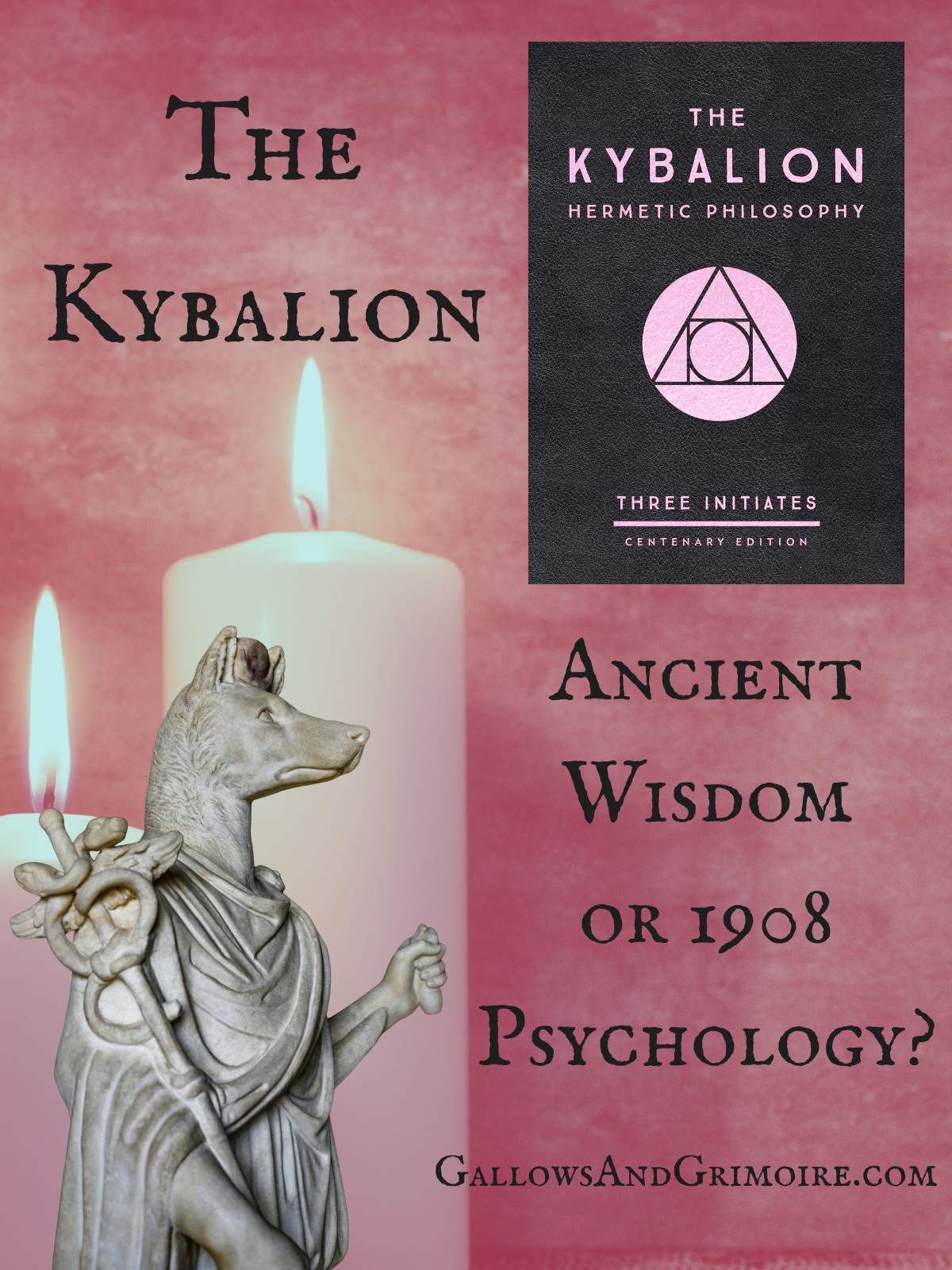
The Kybalion: Ancient Wisdom or 1908 Psychology?
If you’ve spent any time in modern occult spaces, you’ve likely encountered The Kybalion. Its Seven Principles are practically shorthand for modern energy work and mindset. But there’s a persistent myth hovering over this little book: the idea that it’s a direct transmission of ancient Egyptian or Greco-Roman Hermetic wisdom. It’s not. And once you know the truth about its 1908 New Thought origins, the book doesn’t lose its magic. In fact, understanding what it actually is makes it a much more precise and powerful tool.
At its core, The Kybalion is a short, highly influential book published in 1908 that claims to distill ancient Hermetic philosophy into seven core principles: Mentalism, Correspondence, Vibration, Polarity, Rhythm, Cause and Effect, and Gender. ts stated goal is to teach the reader the art of “Mental Transmutation”—the practice of mastering one’s own mind and emotional states to navigate life more effectively. For over a century, it has served as a gateway text for many modern witches, occultists, and self-help seekers.
The Myth: “The Three Initiates”
The book’s title page credits the authorship to the mysterious “Three Initiates”. The text implies that these figures are custodians of a secret, ancient lineage of Hermetic wisdom, passing down a hidden commentary on the teachings of Hermes Trismegistus that has been kept from the public for centuries. This framing is designed to give the book an aura of unbroken, ancient authority.
The Reality: William Walker Atkinson
Historical and textual evidence overwhelmingly points to a single, much more recent source: William Walker Atkinson (1862–1932).
Atkinson was a prominent figure in the American New Thought movement, a lawyer, and a prolific publisher of early 20th-century occult and self-help literature. The Kybalion was published by the Yogi Publication Society, a Chicago-based imprint that Atkinson himself founded and operated.
Atkinson was known to write under multiple pseudonyms (including “Theron Q. Dumont” and “Swami Panchadasi”) to create the illusion of a diverse, global network of teachers. The “Three Initiates” was almost certainly one of these marketing constructs. Just a clever literary device used to lend an air of ancient, collective authority to what was actually a modern synthesis of New Thought psychology, Mesmerism, and selective Hermetic axioms.
Why This Distinction Matters
Knowing that Atkinson wrote the book doesn’t make it useless. It just recontextualizes it. When we read The Kybalion as a brilliant piece of early 20th-century psychological and New Thought literature, its advice on emotional regulation and mental framing becomes incredibly practical. It’s when we mistake it for an authentic, ancient Egyptian or Greco-Roman text that we run into historical and philosophical contradictions.
Under the Hood: Where The Kybalion Diverges from Antiquity
To understand why The Kybalion isn’t an ancient text, we have to look at its actual mechanics. When we put it side-by-side with genuine Hermetic writings (like the Corpus Hermeticum or the Asclepius), the philosophical DNA doesn’t match.
Here are the three biggest giveaways.
- The Human Brain vs. The Divine Mind (Mind vs. Nous)
The Kybalion opens with the Principle of Mentalism: “The All is Mind; The Universe is Mental.” It teaches that by mastering your own human mind, you can perform “Mental Transmutation” to alter your reality. It frames the mind as a tool for personal agency and psychological self-mastery.
The Ancient Reality:
Actual Hermeticism centers on Nous (the Divine Mind or Divine Intellect). In ancient texts, Nous is not the human brain, nor is it a tool you use to “hack” the universe. It is the very intellect of God.
Ancient Hermeticism teaches that the human mind (logos) is a reflection of the Divine, but the goal isn’t to use your brain to manipulate physical reality. The goal is gnosis—a direct, ecstatic, revelatory knowledge of the Supreme God. You don’t master Nous; Nous elevates and saves you. As Hermetic scholar Brian Copenhaver points out in his translations of the Corpus Hermeticum, ancient Hermeticism is a soteriological (salvation-based) religion focused on the soul’s ascent, not a manual for psychological self-help.
- The Missing Reverence (The Eusebia Problem)
Perhaps the most glaring difference is the text’s attitude toward the divine. The Kybalion is explicitly anti-theological. It famously dismisses religion, stating: “The half-advanced man is a theologian… but the fully advanced man knows.” It treats theology as “broken reeds rooted in the quicksands of ignorance.”
The Ancient Reality:
You cannot practice ancient Hermeticism without Eusebia (piety, reverence, or devotion). In the actual Hermetic texts, reverence for the Creator is the absolute prerequisite for any spiritual work.
The Corpus Hermeticum is filled with prayers, hymns, and deep, poetic reverence for the divine. The ancients believed that approaching the divine with a purely analytical, detached, or “advanced” mindset devoid of piety was actually a spiritual failure. The Kybalion’s dismissal of theology is a classic hallmark of 19th-century secularism and New Thought, which sought to replace traditional religion with “scientific” mental laws.
- 19th-Century Physics in Ancient Clothing (Anachronistic Concepts)
The Kybalion relies heavily on concepts like “Vibration” (“Nothing rests; everything moves; everything vibrates”) and “Polarity” (“Everything is dual; everything has poles”). Because these words sound mystical, readers assume they are ancient Egyptian concepts. They aren’t.
The Ancient Reality:
Vibration: The ancient Hermetic texts do not talk about “vibrational frequencies.” The concept of “vibration” as a spiritual law was co-opted in the 18th and 19th centuries from early physics, David Hartley’s vibration theory of neuroscience, and Mesmerism. By the late 1800s, it was a staple of Theosophy and New Thought (Atkinson himself wrote extensively on “Thought Vibration” years before The Kybalion).
Polarity: The idea that “hate and love are the same thing, just different degrees on a scale” and can be transmuted by shifting your mental polarity is pure 19th-century New Thought psychology. It is the exact framework Atkinson used in his 1906 book Thought Vibration or the Law of Attraction in the Thought World.
Ancient Hermeticism deals with dualities (like light/dark, male/female, mortal/immortal) as cosmic opposites that reflect the divine unity, but it does not treat them as a psychological sliding scale you can manipulate to turn a bad mood into a good one.
The Takeaway for Modern Practice
None of this means the concepts in The Kybalion don’t work. “Mental Transmutation” is a highly effective psychological tool for emotional regulation. “Polarity” is a great framework for cognitive reframing.
But recognizing these as 19th-century psychological tools rather than ancient Egyptian magic laws changes how we use them. It frees us from the burden of historical inaccuracy and allows us to appreciate The Kybalion for what it is: a brilliant, pragmatic synthesis of early 20th-century mental science.
And if you do want to work with ancient Nous, ancient Eusebia, and ancient Hermetic dualities? You just have to open the actual ancient texts.
Actionable Takeaways: How to Practice With This Information
So, where does this leave us as modern practitioners? You don’t have to throw The Kybalion in the trash, but you do need to change how you categorize it on your bookshelf and in your mind.
- Compartmentalize Your Tools
Use The Kybalion for what it actually is: a highly effective, early 20th-century manual for psychological self-mastery, emotional regulation, and cognitive reframing. Its principles are great for clearing your head before a working. But do not use it as your theological foundation for ancient Hermetic magic. - Own the Lineage
If you work with The Kybalion, own its actual lineage. It is a product of the American New Thought movement and early 20th-century occult syncretism. That is a valid and interesting historical lineage on its own. It doesn’t need to borrow unearned antiquity from ancient Egypt to be useful. - Embrace the Actual “Weirdness” of Antiquity
When you do step into actual ancient Hermeticism, don’t try to smooth it out into modern self-help. Ancient Hermeticism is strange, beautiful, and deeply theological. It deals with cosmic realms, the descent of the soul, planetary spheres, and intense, ecstatic devotion. Let it be weird. Let it be ancient.
The Reading List: Where to Find the Real Hermetica
If you want to work with the actual Nous, practice true Eusebia, and read the source material that inspired the Western esoteric tradition, start here. These are the primary texts of classical Hermeticism.
For the Best Reading Experience:
The Way of Hermes: New Translations of the Corpus Hermeticum (Clement Salaman, et al.)
This is the most accessible, poetic, and readable modern translation of the core Greek Hermetic texts. It captures the spiritual and devotional tone of the original writings beautifully. If you only buy one book on this list, make it this one.
For the Academic Gold Standard:
Hermetica: The Greek, Latin, and English Fragments of the Corpus Hermeticum (Brian P. Copenhaver)
Copenhaver’s translation is the scholarly standard. It is denser and includes massive, incredibly detailed footnotes that contextualize the texts within Greco-Roman philosophy, Egyptian religion, and early Christianity. It’s essential if you want to understand the historical reality of the Hermetic tradition.
For the Apocalyptic/Prophetic Angle:
The Asclepius (Included in both of the above, but worth seeking out separately)
This is the only complete Hermetic text that survives in Latin (rather than Greek). It has a very different vibe from the Corpus Hermeticum. It is highly prophetic, featuring Hermes predicting the fall of Egyptian religion and the coming of a dark age. It’s a fascinating, somewhat darker look at the Hermetic worldview that contrasts sharply with the optimistic “Law of Attraction” vibe of The Kybalion.
Misinformation thrives when we prioritize the aesthetic of magic over the reality of it. Stripping away the myth of The Kybalion’s antiquity doesn’t weaken your practice. It strengthens it, because it forces you to choose your tools based on what they actually do, rather than what they claim to be.